What Is Data Governance?
A comprehensive guide to data governance and compliance systems — protect your organization’s data and meet PDPL requirements and regional data protection standards effectively.
What Is Data Governance?
In 2022, a major Gulf airline launched an ambitious data analytics initiative aimed at improving the customer experience. Six months in, the project team discovered that the same customer existed in six different forms across six different systems — each system using a slightly different name, and in some cases a different email address and date of birth.
The initiative stalled. Not because the analytical capability was lacking, but because the underlying data was not reliable enough to build anything meaningful on top of it.
That story captures why data governance matters far more than its name might suggest.
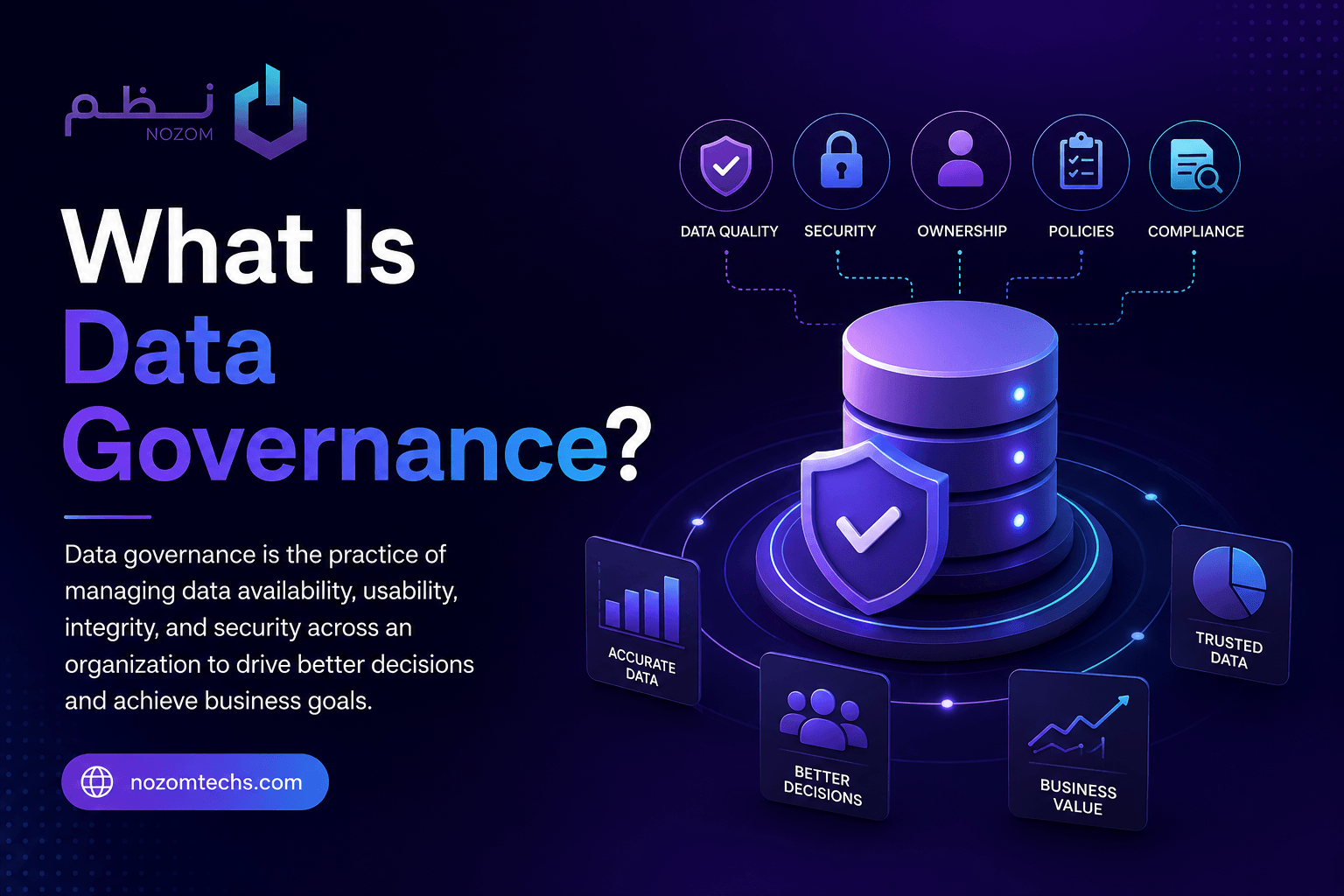
Data governance is the framework that determines how data is collected within your organization, who owns it, who can access it, how it may be used, how it is protected, how long it is retained, and how it is disposed of when it is no longer needed.
Put simply, data governance answers two foundational questions:
-
"Who is responsible for this data?"
-
"What rules govern how it is handled?"
But in practice, data governance extends well beyond those two questions. It is an integrated system of processes, policies, technologies, and people — with one core objective: ensuring that your organization's data is trustworthy, secure, and compliant with regulatory requirements, while remaining genuinely usable by the people who need it.
Read also: Data Privacy and Protection
Components of a Data Governance Framework
1. Data Policies
Policies are the backbone of any governance framework. They address three essential areas:
-
Data classification: Which data is highly confidential, which can be shared internally, and which may be made public. In the Gulf context, personal data belonging to citizens and residents requires special treatment under applicable data protection regulations.
-
Data lifecycle: From the moment data is collected or created to the point it is deleted or archived — every stage should be governed by clear, unambiguous rules.
-
Acceptable use: What purposes data may be used for, including sharing with vendors, partners, and analytics providers — not just internal use.
2. Data Standards
Standards ensure that data carries a consistent meaning across the organization. This sounds obvious — until you discover that "annual revenue" in your CRM is calculated differently from "annual revenue" in your ERP, making any report that draws from both sources inherently misleading.
Standards cover:
-
Precise field-level definitions.
-
Unified formats for dates, numbers, and addresses.
-
Validation rules that define what constitutes a valid or invalid value.
-
Centralized data dictionaries that function as the organization's authoritative reference.
3. Data Ownership
Every dataset must have a clear owner — and that owner should not be the IT department. A data owner is the business-side stakeholder who understands the nature of the data and bears accountability for its quality and accuracy.
The practical difference is straightforward: when you discover that your CRM contains a large percentage of invalid phone numbers, who do you call — the sales team that owns the customer relationship, or the IT team that owns the system? In a governance-mature organization, that question does not require a debate.
4. Data Access Controls
Access governance means simply that the right person accesses the right data for the right purpose at the right time — no more, no less.
This includes:
-
Clear identity and access management.
-
Application of the principle of least privilege (so no employee holds access beyond what their role genuinely requires).
-
Comprehensive access logs.
-
Periodic reviews to ensure that permissions do not accumulate unchecked over time.
5. Privacy and Security
Privacy and security are two sides of the same coin. Privacy addresses individuals' rights over their data — the right to access it, correct it, and have it deleted. Security addresses the technical controls that make those rights real rather than merely notional.
In the Gulf, this dimension has become decisive with the full implementation of Saudi Arabia's Personal Data Protection Law (PDPL), alongside evolving equivalent frameworks in the UAE, Bahrain, and Kuwait.
Read also: Data Protection
Data Governance and Regulatory Compliance in the Gulf
Saudi Arabia's Personal Data Protection Law (PDPL)
The PDPL has entered full enforcement through a phased implementation timeline. Its core requirements include:
-
Obtaining explicit consent before collecting personal data.
-
Providing clear disclosure of collection and use purposes.
-
Granting individuals the right to access, correct, and delete their data.
-
Reporting data breaches promptly.
-
Ensuring that any cross-border data transfers satisfy the law's specified conditions.
A practical example: A Saudi e-commerce company using a US-based analytics platform must verify that transferring its customer data to servers outside the Kingdom meets PDPL's cross-border transfer requirements.
Sector-Specific Requirements
Beyond PDPL, each sector carries its own overlay of requirements:
-
Financial Services (SAMA): Enforces sophisticated data governance frameworks across financial services, covering data retention, secure transfer standards, and incident response timelines.
-
Healthcare: Health data is subject to additional confidentiality and use restrictions amid the sector's rapid digitization.
-
Telecom & Tech (CST): The Communications, Space & Technology Commission sets precise requirements around subscriber data retention and disclosure to regulatory authorities.
Digital Sovereignty and Data Localization
There is a growing regional trend toward requiring sensitive data to be stored locally. This creates real governance challenges for organizations operating on global cloud architectures, and corresponding opportunities for local cloud infrastructure providers such as STC Cloud and G42.
Read also: Data Lakes
Data Quality: The Foundation Everyone Overlooks
You can build the most rigorous policy framework and the tightest access controls — but if the underlying data is unreliable, everything built on top of it becomes structurally unsound. Data quality is the most consistently overlooked dimension of data governance, and it is frequently the reason large analytical initiatives fail.
Data quality is assessed across five dimensions:
-
Accuracy: Does the data reflect reality? A customer address from three years ago may be "complete" and "properly formatted" — and completely wrong.
-
Completeness: Are the critical fields populated? A customer record without a phone number may be essentially worthless to the entire sales team.
-
Consistency: Does the same piece of information say the same thing across all systems?
-
Timeliness: Is the data current enough for the purpose it serves?
-
Validity: Do the values fall within the expected and logical range?
The most common mistake in this area is believing that data quality is a problem solved once. In reality, data quality degrades naturally over time — people relocate, companies restructure, prices shift, and information becomes stale. Successful programs build ongoing quality maintenance processes rather than relying on periodic cleanup projects.
Roles and Responsibilities in Data Management
-
Data Governance Council: The governing body that brings together senior leadership and heads of key business units. It sets strategic priorities, approves major policies, and serves as the line of communication with the board of directors.
-
In the Gulf market, many organizations have not yet established a dedicated CDO role, distributing these responsibilities among the CTO, CIO, and Chief Compliance Officer. That arrangement works in the early stages, but as data dependency grows, the need for a dedicated CDO shifts from a nice-to-have to a strategic necessity.
-
Data Stewards: Data stewards are the operational heart of governance. They work at the departmental level, taking daily responsibility for data quality within their domain and ensuring policies are applied in practice. They are the functional bridge between strategic direction and on-the-ground execution.
-
Data Owners: Business-side managers accountable for specific data sets. The sales director is the natural owner of prospect and customer data; the HR director is the natural owner of employee records. Ownership here means accountability for accuracy and appropriate use — not technical control over systems.
-
Privacy Officers: With the enforcement of data protection regulations, a Data Protection Officer (DPO) has become a legal requirement in many sectors and for organizations that process personal data at scale.
The Difference Between Data Governance and Data Management
Confusing these two terms is common and costly — because it leads to assigning the wrong team to the wrong task.
-
Data governance answers the who, why, and what — who owns the data, why policies exist, what rules govern its use. It is the strategic and policy layer.
-
Data management answers the how — how data is collected, stored, integrated, cleansed, and distributed. It is the technical and operational execution layer.
The relationship is clear: governance sets the rules; management implements them. You cannot manage data effectively without governance, and governance without management is policy that never reaches the ground.
A practical example: A policy stating that inactive customer data must be deleted after seven years is a governance decision. The process of identifying that data, executing the secure deletion, and documenting the action for audit purposes is data management.
Building a Successful Data Governance Program
Step 1: Understand What You Have First
Before taking any action, map the current landscape. What data does the organization hold? Where does it reside? How does it flow between systems, departments, and external parties? And where do the current vulnerabilities lie?
This assessment frequently surfaces surprises. Organizations have discovered legacy systems holding sensitive data that everyone had forgotten existed, or active data flows to third parties that no one realized were still running.
Step 2: Establish Clear Priorities
Not everything can be addressed at once. Prioritize data that is subject to binding regulatory requirements, used in critical strategic decisions, or carries the highest privacy and security risk.
Step 3: Build the Organizational Structure Before the Tools
Technology cannot close institutional gaps. Before selecting any platform, the organization must have a clear ownership structure: who owns the data, who governs it, and who makes the call when interests conflict.
Step 4: Select the Right Tools
-
Data catalog platforms — such as Alation, Collibra, and Microsoft Purview — provide a centralized inventory of data assets, lineage and context tracking, search capabilities that make the right data easy to find, and automated classification of sensitive data.
-
Data quality tools — such as Informatica, Talend, and dbt — provide cleansing, validation, and enrichment capabilities.
Step 5: Treat Change Management as a First-Class Priority
This is the step most consistently underestimated — and the reason many technically sound programs fail. Data governance requires changing the behavior of dozens or hundreds of employees in how they enter, share, and describe data. That does not happen by simply launching a new platform.
Key Challenges in the Gulf Context
-
The Legacy Systems Inheritance: Many large Gulf organizations have built their technology infrastructure across decades. The result today is data scattered across SAP, Oracle, Dynamics AX, custom-built systems, and countless spreadsheets. Unifying and governing that inheritance is a substantial technical and organizational challenge simultaneously.
-
A Leadership Perception Gap: In some organizations, data governance is still viewed by senior leadership as an IT project rather than a business decision. Without top-level sponsorship and a defined budget, these initiatives consistently give way to day-to-day operational pressures.
-
Talent Scarcity: Experienced data stewards and privacy consultants with deep knowledge of Gulf-specific regulations are in short supply. Demand clearly outpaces supply in the regional talent market.
-
Organizational Culture: In environments where data is treated as a departmental asset to be protected rather than shared, building a culture of data collaboration requires effort that goes well beyond tools and policies.
Best Practices
-
Start with a concrete business problem, not a theoretical framework: Identify a real, felt pain — conflicting reports that create friction between departments, customer data that blocks marketing campaigns, delays in producing compliance reports — and deliver a visible early win that earns leadership support.
-
Write policies that can actually be enforced: A policy that gets read in meetings and ignored in practice has no value. A good policy is written by someone who understands the realities of day-to-day operations and reviewed by those who will implement it.
-
Measure what matters: Track data quality scores, compliance reporting turnaround times, unauthorized access incidents, and data classification coverage rates. Quantifiable metrics demonstrate the program's value and identify where it needs improvement.
-
Integrate it into the broader GRC framework: Data governance is not a standalone program. Embedding it within the enterprise GRC framework ensures that data risks are identified and addressed as part of the organization's complete risk management picture.
-
Make education continuous, not seasonal: An annual workshop does not change behavior. Successful programs weave data awareness into the daily routine — timely reminders, real-world case studies, and relevant updates when they matter most.
Frequently Asked Questions (FAQ)
What is the difference between data governance and data security?
Data security is one component of data governance — it addresses technical protection such as encryption, access controls, and intrusion detection. Data governance is broader, encompassing the strategic, organizational, and operational dimensions of how data is managed as a whole.
Do small companies need a formal data governance program?
Size is not the determining factor — the nature of the data is. A small company handling sensitive medical, financial, or personal data requires rigorous governance controls regardless of its headcount.
How long does it take to build a mature data governance program?
Serious programs typically require 18 to 36 months to reach an acceptable level of maturity. Early results, however, can often be visible within 3 to 6 months. This is a continuous improvement program, not a project with a defined end date.
What is the relationship between PDPL and data governance?
PDPL establishes legal requirements that become an integral part of any data governance framework. Compliance with PDPL necessarily requires clear policies, defined roles, and the ability to track and demonstrate adherence — all core elements of a mature data governance program.
What are the most common mistakes in building a data governance program?
Starting with the tool rather than the strategy; focusing on technical compliance while neglecting data quality; lacking active leadership sponsorship; and attempting to address everything at once rather than pursuing a phased, strategic approach.
Conclusion
Data governance in today's Gulf business environment is an investment in the organization's capacity to make better decisions, build deeper trust with customers, partners, and regulators, and extract real value from data assets that are accumulating at an accelerating pace.
With data protection regulations now in full enforcement and digital transformation continuing to amplify both the volume and complexity of organizational data, those that have built a data governance infrastructure today will find themselves in a meaningfully stronger competitive position tomorrow. Those that defer will typically discover their gaps at the point when closing them has become far more expensive.