Why Enterprise Architecture Matters | The Role of Enterprise Architecture in Digital Transformation
Enterprise architecture connects strategy to execution. Here is why it is critical for digital transformation and long-term enterprise scalability.
Why Enterprise Architecture Matters in Digital Transformation
Let me start with a scene you've probably lived through.
A company decides to "go digital." Budget gets approved. Over two years they buy a new CRM, a new HR platform, a data warehouse, three analytics tools, and a handful of apps each department picked on its own. Everyone's busy. Everyone's shipping. And at the end of it, leadership asks a simple question: did anything actually get better?
Nobody can answer cleanly. The CRM doesn't talk to billing. Two teams are paying for tools that do the same job. A report that should take an hour takes a week because the numbers live in four places that disagree with each other. The transformation happened. The results didn't.
That gap, between spending on technology and actually getting value from it, is exactly the gap enterprise architecture exists to close.
Quick Answer
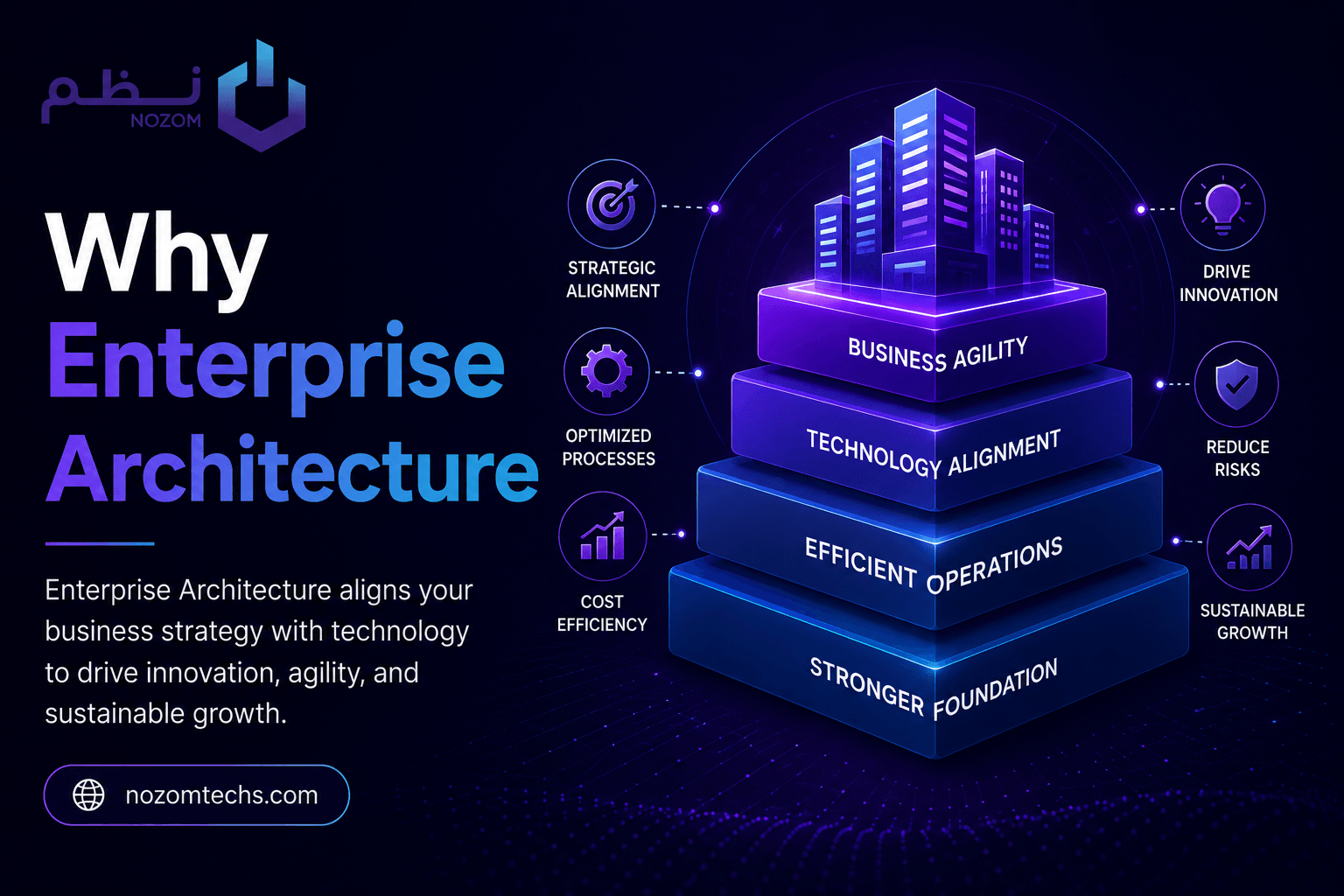
Enterprise architecture is the discipline of mapping how your business, data, applications, and technology fit together, and using that map to make sure every change moves the whole organization toward its strategy. It connects high-level goals to the systems that deliver them. Done well, it stops you from buying the wrong things, building the same thing twice, and accumulating technical debt you can't unwind later. Frameworks like TOGAF and Zachman give it structure.
What enterprise architecture actually is
Strip away the jargon and enterprise architecture is one thing: a shared, honest picture of how the organization really works, plus a deliberate plan for how it should work next.
It usually covers four connected layers. Business architecture, the capabilities, processes, and people. Data architecture, what information you hold and how it flows. Application architecture, the systems and how they integrate. And technology architecture, the infrastructure underneath. The whole point is that these four are looked at together, not in isolation by separate teams who never compare notes.
That's the part most companies miss. IT plans technology. Operations plans process. Finance plans budget. Each plan is reasonable on its own, and the sum of them is a mess. Enterprise architecture is the function that sits across all of them and asks the awkward question nobody else owns: does this actually hang together?
Why it matters now more than ever
You could half-ignore this fifteen years ago. You can't now, and the reason is digital transformation.
When change was slow, an incoherent system landscape was just annoying. Today the landscape changes constantly, cloud, AI, automation, new platforms every quarter, and incoherence becomes expensive fast. Every poorly planned system you bolt on makes the next change harder. That's how organizations end up "transforming" for years and feeling like they're standing still.
Enterprise architecture is what keeps a transformation strategy connected to execution. It's the difference between a digital transformation strategy that's a slide deck and one that's actually wired into the systems people use every day. Without it, strategy lives at the top, projects happen at the bottom, and the two quietly drift apart.
There's a regional angle too. For organizations aligned with Saudi Vision 2030, the pressure to deliver measurable digital outcomes is real, and working from a recognized reference architecture like NORA is increasingly how government and regulated entities prove their transformation is structured, not improvised.
The frameworks that give it shape
You don't build enterprise architecture from a blank page. A few established frameworks give you the vocabulary and the method.
TOGAF is the most widely used. It's less a rulebook and more a repeatable process for moving from where you are to where you want to be. Zachman is older and more of a classification system, a way to make sure you've thought about every angle (what, how, where, who, when, why) for every layer. Most real programs don't pick one purist framework; they borrow a sensible EA framework like TOGAF and adapt it to how the organization actually operates.
The framework matters less than the habit. The value isn't in the document. It's in forcing the organization to think before it builds.
What good enterprise architecture actually delivers
Here's where it stops being abstract.
It gives you a clear map of where you are today and where you want to be. That as-is and to-be picture is what turns "we should modernize" into a sequenced, fundable plan instead of a vague ambition.
It translates strategy into a target operating model, so the way the business is meant to run on paper actually matches the systems and processes underneath it.
It cuts duplication. When someone can see the whole application portfolio on one map, the three tools doing the same job become obvious, and so does the integration that was never built.
It controls technical debt. Every shortcut taken under deadline pressure is a loan against the future. Enterprise architecture is what keeps that debt visible and deliberate instead of a nasty surprise three years later.
And it strengthens IT governance. When every proposed change is checked against a shared architecture, decisions stop being "whoever shouts loudest" and start being "does this fit the direction we agreed."
With architecture vs without it
Without enterprise architectureWith enterprise architectureHow decisions get madeDepartment by department, in isolationAgainst a shared, organization-wide viewTechnology spendOverlapping tools, surprise costsDeliberate, mapped to capabilitiesIntegrationBolted on later, if at allPlanned from the startStrategy to executionDrifts apart over timeStays connected and traceableTechnical debtInvisible until it hurtsVisible and managedSpeed of changeSlows as systems pile upSustained, because the base stays clean
How to actually start
You don't need a hundred-page document on day one. You need momentum in the right order.
Start with the business, not the technology. Map your core capabilities and how strategy depends on them before you touch a single system diagram. Architecture that starts from servers always ends up serving the servers.
Get the current state on paper honestly. Most organizations are surprised, and a little embarrassed, by what the real map looks like. That discomfort is the point; you can't fix what you won't look at.
Give it a home. Architecture that's "everyone's job" is no one's job. Many organizations stand up a dedicated EA office so there's a clear owner who maintains the map and reviews change against it. Without an owner, the whole thing goes stale in months.
And keep it living. A model in a slide that no one updates is worse than useless, because people trust it while it quietly goes wrong. A proper EA tool such as iServer helps here, keeping the architecture current and connected to real systems instead of frozen in a forgotten file.
Where it gets hard
Even committed organizations hit the same walls.
People treat it as paperwork. If architecture becomes a gate that slows everyone down without visibly helping, teams route around it, and then it's just expensive bureaucracy. It has to earn its place by making real decisions better.
It needs executive air cover. Enterprise architecture cuts across departments, which means it threatens little local kingdoms. Without genuine leadership backing, it gets quietly starved.
The value is real but slow. The payoff, cheaper change, fewer nasty surprises, faster delivery, shows up over years, not weeks. That's a hard sell in a culture that rewards the next quarter. Naming a few near-term wins early matters a lot.
And the skills are scarce. Good architects understand business and technology and how to talk to both. That's a rare mix, which is why many organizations lean on external help to get the function established before building it in-house.
Bottom line
Digital transformation without enterprise architecture is just spending. You buy the tools, you run the projects, and you hope it adds up, but hope isn't a strategy and the bill arrives either way.
Enterprise architecture is what makes the spending intentional, the systems coherent, and the strategy actually reachable from the ground floor. If your organization is investing seriously in technology but can't draw a clear line from that investment to a business outcome, that missing line is the architecture. And the right time to draw it is before the next big project, not after it goes sideways.
FAQ
Isn't enterprise architecture just IT's job?
No, and treating it that way is why so many programs fail. It starts from business strategy and capabilities, then works down to systems. IT is a critical part of it, but architecture that's owned purely by IT ends up optimizing technology instead of the business it's meant to serve.
Do we need to adopt TOGAF to do this?
Not strictly. TOGAF is the most common framework and a solid starting point, but the value comes from the discipline, not the certificate. Most organizations adapt a framework to their context rather than following one to the letter. What matters is having a consistent method everyone uses.
We're a smaller organization. Is enterprise architecture overkill?
The full ceremony might be, but the core idea isn't. Even a lightweight map of your capabilities, systems, and where they overlap will save you from duplicated tools and integration headaches. Scale the formality to your size, not the thinking behind it.
How is this different from digital transformation?
Digital transformation is the journey, changing how the business operates using technology. Enterprise architecture is the map and the steering for that journey. You can attempt transformation without architecture, but you'll usually arrive somewhere expensive and unintended. Architecture is what keeps the transformation pointed at the actual goal.