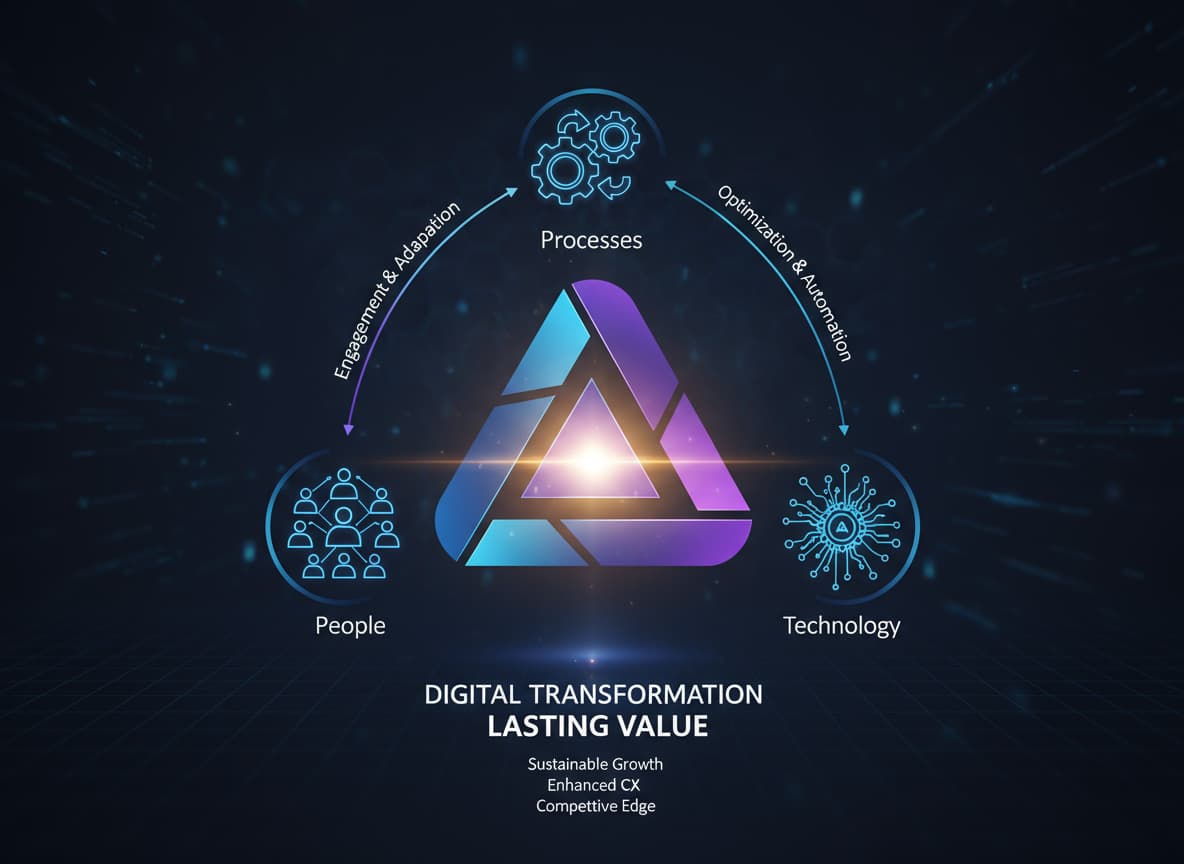
Digital Transformation in Saudi Arabia: Vision 2030 Guide
Digital transformation in Saudi Arabia is driven by Vision 2030, SDAIA, and the NCA. Here is what the rules mean for your roadmap—and where programs fail.
Digital Transformation in Saudi Arabia: What Vision 2030 Actually Means for Your Roadmap
Saudi Arabia isn't transforming. It already transformed.
If you're a CIO sitting in Riyadh, Jeddah, or anywhere across the Kingdom right now, the question stopped being "should we go digital." That conversation ended around 2020. Today the question is sharper. Which specific bets do you make next, given what the regulators just published last quarter?
This piece is about that question.
Quick Answer: Digital transformation in Saudi Arabia is the modernization of how government and private sector organizations deliver services, driven by Vision 2030. It covers cloud adoption, AI, data governance, and cybersecurity under regulators like SDAIA and the National Cybersecurity Authority (NCA). The pace is fast, the rules are real, and compliance is no longer optional.
What digital transformation in Saudi Arabia actually means
It's not just IT modernization. Strip away the slides and the slogans, and what's happening is a coordinated push to rebuild how the entire economy runs on digital infrastructure. The Vision 2030 program set this in motion back in 2016. Since then it's been operationalized by specific agencies with specific mandates — and a credible digital transformation strategy in the Kingdom has to start from those mandates, not from a generic playbook.
SDAIA owns data and AI strategy. The National Cybersecurity Authority sets the security baseline. The Communications, Space and Technology Commission (CST, formerly CITC) regulates the telco and ICT side. The Digital Government Authority handles public sector platforms. Each one publishes binding rules. Not guidance. Rules. This is why successful digital transformation programs here treat regulation as an input to architecture, not an afterthought.
Which means digital transformation in the Kingdom isn't a choice about pace. The pace got chosen for you.
Why this matters to enterprises right now
The regulatory floor keeps rising
The Personal Data Protection Law (PDPL), enforced from September 2023 and updated through 2024, is the clearest example. Every company processing personal data of people in Saudi Arabia, whether the company is based here or not, has obligations. Consent. Lawful basis. Data subject rights. Cross-border transfer controls. Enforcement is real. Penalties exist. Building data privacy and protection into your platforms from day one is far cheaper than retrofitting it.
Then there's the NCA's Essential Cybersecurity Controls (ECC-1:2018, with the ECC-2 update for 2024) and the Cloud Cybersecurity Controls (CCC-1:2020). If you operate in regulated sectors — energy, finance, government, healthcare — these aren't optional. They define the security posture you must hold to operate, which is why cybersecurity and transformation can no longer be run as separate programs.
Cloud went from forbidden to expected
A few years back, getting approval to put sensitive workloads in the cloud was a battle. Now? The Kingdom has its own cloud-first policy for government, hyperscalers have built local regions (Google Cloud, Oracle, Microsoft, Huawei), and the regulators have published cloud-specific control sets. Refusing to consider cloud in 2026 looks dated. Possibly negligent.
How transformation actually unfolds here
Most successful programs I've seen follow a rough pattern. Not a methodology. Just what works.
First, regulatory mapping. Before architecture, before vendor selection, before anything technical, somebody has to translate the rules into a control list. PDPL obligations. NCA controls relevant to your sector. SAMA framework if you're in financial services. Aligning that list to recognized ISO 27001 controls keeps it auditable. Get this wrong and you'll rebuild half your stack later.
Second, data foundation. Almost every interesting transformation use case — customer analytics, AI pilots, automation — breaks if the underlying data is a mess. SDAIA's National Data Management Office published the National Data Management and Personal Data Protection Standards (NDMO standards) for exactly this reason. A disciplined approach to data management is the difference between AI that works and AI that embarrasses you.
Third, the application layer. ERP modernization. Customer platforms. Digital service channels. This is the part that gets the budget and the press releases. It's also the part that fails most often, because the first two foundations weren't ready.
Best practices for digital transformation in Saudi Arabia
Anchor your roadmap to specific Vision 2030 programs, not the slogan. The Vision contains targeted programs like the National Transformation Program and the Financial Sector Development Program. Align your initiatives to the ones that touch your sector — and remember that, increasingly, national vision is a business imperative, not a PR line. Vague alignment to "the Vision" satisfies nobody at a board meeting.
Treat NCA's ECC as your minimum, not your goal. The Essential Cybersecurity Controls define what you have to do. Mature organizations layer ISO/IEC 27001 (2022 revision) and NIST CSF 2.0 (2024) on top. The ECC is the floor, not the ceiling. Treating it as the ceiling is how breaches happen.
Build PDPL compliance into data architecture, not on top of it. Retrofitting consent management, data localization, and subject rights into a system that wasn't designed for them is expensive and fragile. Embedding governance, risk, and compliance at the design stage avoids that. The PDPL Implementing Regulations (2023) give you the specific obligations.
Pick local cloud regions for regulated workloads when available. This isn't just about latency. Data residency requirements for certain sectors and certain data classifications make local regions the path of least regulatory friction. Verify with your legal team based on your specific data classification, but it's often the right default.
Invest in Arabic-language AI capabilities, not just English translations. SDAIA's work on Arabic language models matters more than people realize. Customer service, document processing, government services — any system facing Saudi users needs to handle Arabic natively. Strong AI and data management capability is what makes that real rather than bolted-on.
Where transformation programs go wrong here
Vendor-led strategy. A global consulting firm shows up with a deck built for somewhere else, and the client buys it. Then they discover six months in that the architecture assumes data flows the PDPL doesn't permit. Or that the controls don't map to NCA requirements. Expensive lesson. A defined operating model grounded in local rules prevents it.
Speed without governance. Vision 2030 created enormous pressure to move fast, and some boards interpreted that as skipping foundations. You can launch a digital service channel in three months. You cannot retrofit data governance in three months. Strong transformation governance is the guardrail. When speed and governance collide without it, the channel survives but never really works.
Treating Saudization purely as a hiring metric. The talent strategy that actually delivers transformation invests in upskilling, not just headcount targets. The Human Capability Development Program under Vision 2030 exists for this. Companies that engage with it seriously get a pipeline. Companies that treat it as a compliance number get neither the people nor the outcomes.
What the next 18 to 36 months look like
Sovereign AI is the big one. SDAIA's Generative AI Adoption Framework (2024) signals that the Kingdom is serious about deploying AI in government and regulated sectors, with controls around bias, transparency, and data handling. Expect that framework to harden into binding requirements for specific sectors.
The NCA is moving toward continuous compliance models. The shift away from annual audits toward live monitoring is happening globally, and the Kingdom's regulators are not behind on this. Build for continuous evidence collection now, not later. The same direction is reshaping cybersecurity services across KSA.
A more cautious read on the data center boom. The hype is real, but the actual capacity coming online versus the demand curve — those forecasts vary widely between providers. Don't make multi-year commitments based on a single vendor's projection.
Bottom line
The companies winning at digital transformation in Saudi Arabia right now share one habit. They read the regulations the week they're published. Not when their auditor flags them eighteen months later. Pick one regulator — NCA, SDAIA, SAMA if you're in finance, CST if you're in telecoms — and assign someone in your organization to own the relationship and the rule-tracking. That single appointment changes how your transformation program runs. Make it this week.
FAQ
Do non-Saudi companies have to comply with PDPL?
Yes, if they process personal data of individuals in Saudi Arabia, regardless of where the company is based. The law has extraterritorial reach similar to GDPR. The Implementing Regulations (2023) detail the obligations, and the Saudi Data and Artificial Intelligence Authority enforces them. Verify your specific scope with qualified Saudi legal counsel.
What's the difference between NCA's ECC and CCC?
The Essential Cybersecurity Controls (ECC) define baseline security for organizations operating in the Kingdom, especially in critical sectors. The Cloud Cybersecurity Controls (CCC) layer specifically onto cloud computing services and the relationship between cloud service providers and tenants. If you're using cloud, both apply.
How does Vision 2030 affect private sector transformation specifically?
Vision 2030 sets the strategic direction, and the programs underneath it — like the National Transformation Program — create funding pools, partnership opportunities, and procurement priorities that private companies can align to. Sectors like tourism, entertainment, mining, and renewable energy have specific Vision-linked initiatives that change the commercial environment your transformation is operating in.
Are local hyperscaler regions enough for data residency?
Often yes, but not automatically. Data residency requirements depend on your sector, your data classification, and which regulator oversees you. SAMA-regulated entities face different rules than retail businesses. Confirm your specific obligations before assuming a local region solves the question.