What Is AI Security? Enterprise Risks and Best Practices
AI security protects models, data, and AI-driven decisions from new categories of risk. Learn the threats every enterprise should plan for now.
In 2023, Samsung banned its staff from using ChatGPT. The reason wasn't a hacker. It was engineers pasting internal source code into the tool to debug it faster, not realizing where that code might end up.
That story tells you most of what you need to know about AI security. The scariest exposure in the AI era often doesn't come from an attacker breaking in. It comes from a well-meaning employee, and from systems nobody in the security team knew were running.
For two decades, security teams built defenses for networks, endpoints, applications, and identities. AI breaks the frame. When a model makes business decisions, writes customer-facing content, or touches sensitive data at scale, the question stops being "how do we protect the system." It becomes: how do we protect the system, the model, the training data, the inputs, the outputs, and every decision the model sets in motion downstream.
Quick Answer
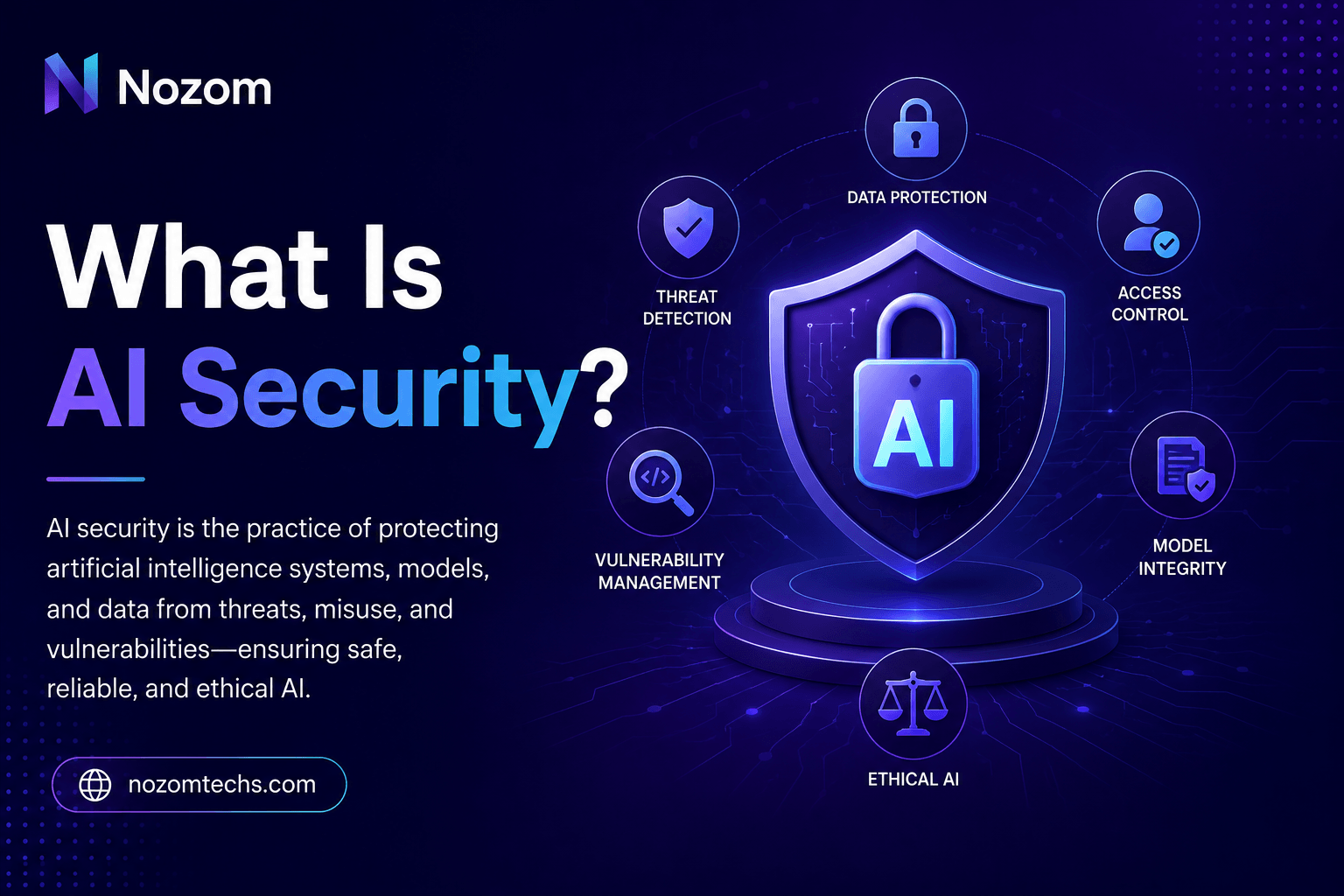
AI security is the practice of protecting AI systems, their models, training data, and AI-driven decisions, from threats that traditional security tools miss. It covers attacks unique to AI, such as prompt injection, data poisoning, and model theft, and the use of AI by attackers. Frameworks like the NIST AI Risk Management Framework, ISO/IEC 42001, and the EU AI Act shape it.
What AI security actually means
AI security has two faces, and people confuse them constantly.
The first is defending the AI systems themselves: the data they learn from, the models they produce, the pipelines that retrain them, the interfaces that expose them to users. This looks a little like application security, but with whole categories of weakness that classical tools simply don't see.
The second is defending against AI-powered attacks: phishing written by language models, deepfakes in social engineering, automated reconnaissance, malware that adapts on the fly. Attackers already have these capabilities. Defenders need their own.
A serious program covers both. Pick one and you've left a wide blind spot where the other lives.
Why AI risk is genuinely different
It's tempting to file AI security under existing cybersecurity and move on. That instinct underrates what's actually new.
Traditional applications are deterministic. Same input, same output, every time. Models aren't. Their behavior is probabilistic, sensitive to tiny shifts in input, and shaped by data they swallowed during training. A few consequences follow that didn't exist before.
The integrity of training data becomes a security property in its own right. The model itself turns into intellectual property that can be stolen just by querying it enough times. User inputs can bend the model's behavior in directions its builders never intended. Outputs can leak things the model was never supposed to reveal. And a model's decisions can carry bias, error, or outright hallucination straight into a business process.
You can't patch a server to fix any of these. They need new controls, not recycled ones.
The core categories of enterprise AI risk
Every vendor has its own taxonomy. In practice, the risk clusters into five areas.
Data risk. A model inherits everything from its training data, including the errors, the bias, and the secrets. A poisoning attack slips malicious data into the training pipeline, nudging the model's behavior in ways that may never show up in testing. And the reverse: a model fine-tuned on customer records, contracts, or source code can leak that very data in its answers.
Model risk. The model is now an asset with a price tag. Adversaries run model extraction, querying an exposed model repeatedly until they can rebuild a close copy. Model inversion tries to recover training data from outputs. And adversarial examples tweak an input so a human sees nothing wrong while the model misclassifies it, which matters enormously in computer vision and fraud detection.
Operational risk, especially for LLMs. Prompt injection is the signature threat of the generative era. An attacker hides instructions inside content the model reads, a document, a web page, an email, and the model follows the attacker instead of you. According to OWASP's Top 10 for LLM Applications, prompt injection sits at the top of the list, and there's still no single fix that eliminates it. Hallucination isn't an attack, but it becomes a security problem the moment a fabricated output flows into a contract or a customer message.
Governance and shadow AI. Here's the part I'd argue is the fastest-growing risk in most enterprises, and it isn't technical at all. It's the sprawl of unsanctioned AI use: employees pasting confidential data into public chatbots, business units buying AI tools with no security review, models deployed that nobody is tracking. No inventory, no governance. No governance, and every other control is theoretical.
Supply chain risk. Most enterprises don't train their own foundation models. They consume a handful of them through APIs. That concentration means a flaw in one popular model ripples out to everyone using it. Open-source weights bring a different worry, since a downloaded model can carry a backdoor that no conventional malware scanner is built to catch.
AI risk versus traditional security risk
Dimension
Traditional security
AI security
Primary asset
Systems and data
Models, data, pipelines, decisions
Failure mode
Confidentiality, integrity, availability
All of that, plus accuracy, bias, explainability
Attack surface
Networks, endpoints, identities, apps
Training data, model weights, inputs, outputs, MLOps
Detection
Logs, signatures, behavior analytics
Output monitoring, drift detection, red teaming
Tooling maturity
Decades of established products
Emerging, fragmented, fast-moving
The regulatory and standards picture
Security and governance are converging fast in regulation. Three reference points are worth knowing if you operate across jurisdictions.
The NIST AI Risk Management Framework (AI RMF 1.0, 2023) is voluntary in the United States, but federal agencies and contractors lean on it more every quarter. It organizes the work into four functions, govern, map, measure, and manage, and it's loose enough to fit an organization at any maturity level.
The EU AI Act, phasing in from 2024, takes a risk-tiered approach, with strict obligations for high-risk systems in areas like employment, credit, and critical infrastructure. The penalties are serious, and its extraterritorial reach pulls in non-European companies serving European users.
ISO/IEC 42001 (2023) is the first international management-system standard for AI, built much like ISO 27001. It's becoming the baseline for organizations that need to show auditable AI governance to customers, regulators, and partners.
These frameworks don't replace technical controls. They set the governance environment those controls live inside.
Practical best practices
I'll order these by impact, not as an even list, because some matter far more than others.
Start with an AI inventory, before anything else. You cannot secure what nobody knows exists, and the inventory is the step that surfaces shadow AI before an incident does. Catalog every use case, model, dataset, and integration, and keep it current.
Then put real human accountability in place. Every AI-driven decision should map to a named owner. A model does not absolve the organization of responsibility for what it produces, and "the algorithm decided" is not a defense anyone wants to give a regulator.
Red team your models on a schedule. Test against prompt injection, jailbreaking, adversarial inputs, and data extraction, and make the findings drive fixes rather than decorate a report. Major providers have built detection for prompt injection, but leaning on theirs alone is a mistake, because your context isn't their context.
Apply data minimization with discipline. Fine-tuning a model on more data than you need creates leakage risk that compounds over time. The old privacy principle earns its keep in security too.
Monitor inputs and outputs at runtime. A lot of AI risk only becomes visible in production, so logging prompts, responses, and decisions is what makes detection and investigation possible at all.
Treat MLOps pipelines as critical infrastructure. Data ingestion, model registries, and deployment pipelines deserve the same access controls, integrity checks, and audit logging you'd give a production system.
And educate the workforce, because most leakage to public tools happens through ordinary employees who don't see the risk. Policy alone changes nothing. Training plus an easy sanctioned alternative is what actually moves behavior. The Samsung case began exactly where this control was missing.
The challenges you'll actually hit
Even well-funded programs run into the same friction.
Speed of change is the first. The threats, the tools, and the regulatory expectations all move faster than most security organizations can adapt, and a static policy ages out within months.
Ownership is the second. AI security touches data science, engineering, security, privacy, legal, and the business. Without an explicit operating model, accountability drifts, and the gaps between functions quietly become the real attack surface.
Measurement is the third. Traditional security metrics translate poorly to AI, and the industry hasn't agreed on what the new ones should be yet.
Talent is the fourth, and it's underrated. The overlap of machine learning and security is a narrow specialty, and building it in-house takes time. Until it exists, partnerships fill the gap, which is a reasonable bridge as long as you know it's a bridge.
Future outlook
Three shifts will shape the next few years.
Regulation will keep expanding and converging, even where the details differ by country. The window where you could deploy AI with no governance evidence is closing.
Tooling will mature quickly. Today, teams stitch monitoring, red teaming, and policy enforcement together from several vendors. Expect integrated platforms to consolidate the category, the way cloud security tools consolidated a decade ago. A note of caution worth keeping: many "AI-driven security" claims still run ahead of practitioner consensus, and a tool that promises to catch every threat automatically tends to drown you in false positives.
And AI itself will become central to defending against AI-enabled attacks. Security operations using language models for triage and response are already moving from pilot to production. The question is no longer whether to use AI in the SOC, but how to do it without creating the very exposure you're trying to prevent.
Conclusion
AI is moving from experiment to infrastructure inside most enterprises, and the controls that protected the last generation of systems are necessary but not enough for this one. Build AI security as a discipline now, starting with the one question you can answer or can't today: how many AI tools are running inside your organization, and who owns the security of each. If you can't answer it, that's not a gap to schedule. It's this week's work.
FAQ
**Are public AI tools safe for company data?**Not by default. What you put into a public tool can leave your control, and the 2023 Samsung case is the documented example. The working rule: don't feed sensitive data or IP into a service whose data-retention behavior you don't govern. Provide a sanctioned alternative, or employees will use whatever is in front of them.
**How is AI security different from regular cybersecurity?**Traditional security protects systems with predictable behavior. AI security adds a new attack surface: the model itself, its training data, and its open-ended inputs. Threats like prompt injection and data poisoning don't exist in traditional applications and aren't caught by traditional tools. The two are complementary, not interchangeable.
**Where do we start on a limited budget?**Start with the cheap, high-impact moves: inventory your AI use, write a clear policy on what may be fed into which tools, and apply least-privilege to how models reach data. Those three close the widest gaps before you spend anything on specialized tooling.
**Do we need ISO/IEC 42001 certification?**Not always, but it helps when customers or regulators want auditable proof of AI governance. ISO/IEC 42001 (2023) gives you a management-system structure much like ISO 27001. Smaller organizations can adopt its principles without formal certification; regulated ones increasingly find certification worth the effort.