What Is Penetration Testing? vs Vulnerability Assessment
Penetration testing proves what an attacker can actually do—not just list weaknesses. Here is how it differs from a vulnerability assessment, and what good looks like.
What is Penetration Testing? And How It's Different From a Vulnerability Assessment
A scanner finds 4,000 issues in your environment. Your team spends weeks chasing them. Meanwhile, an attacker only needs one.
This is the gap that penetration testing exists to close. Not by counting weaknesses. By proving which ones an adversary can actually chain together to reach something that matters.
People conflate the two exercises constantly. Vulnerability assessments and penetration tests show up on the same procurement line. They get scoped together. Reported in the same dashboard. Yet they answer entirely different questions, and treating them as interchangeable is one of the more expensive mistakes I see in security programs.
Quick Answer: A penetration test is an authorized, goal-oriented attack simulation against a defined target, performed by skilled testers to prove what an attacker could achieve. A vulnerability assessment is a broader, scanner-driven inventory of weaknesses, scored but not exploited. Pen tests measure real-world risk. Vulnerability assessments measure exposure breadth.
What is penetration testing?
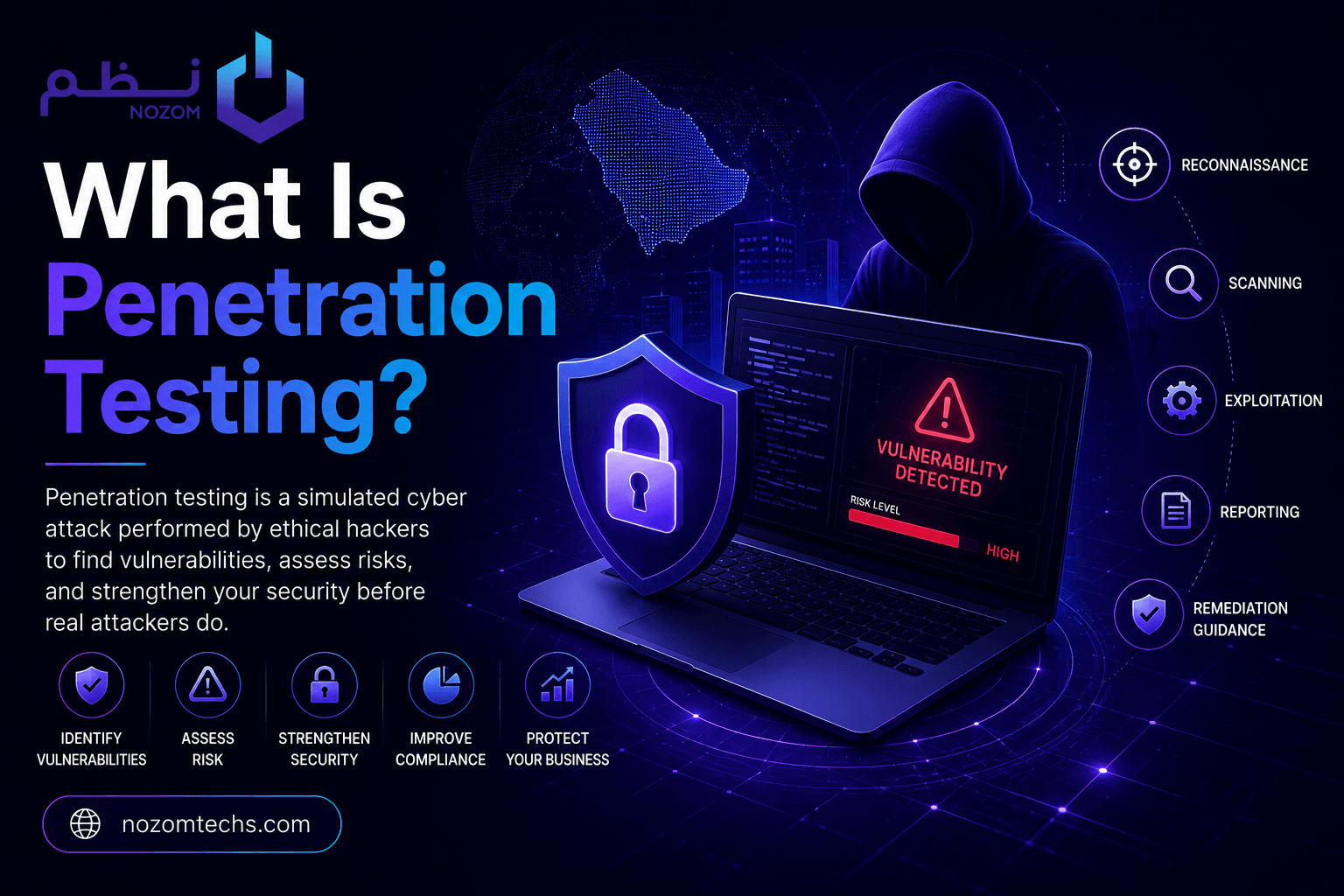
A penetration test is an authorized engagement where qualified testers attempt to compromise a defined target the same way a real attacker would. The target might be a web application, an internal network segment, a cloud tenant, a specific business process, or all of the above in a red team scenario. This is the core of any offensive security practice — and a discipline that sits at the sharp end of modern cybersecurity.
The work follows a structured methodology. Reconnaissance. Threat modeling. Exploitation. Post-exploitation. Reporting. Most professional engagements anchor to one of two references: the Penetration Testing Execution Standard (PTES) or the OWASP Testing Guide (v4.2) for application work. The MITRE ATT&CK framework (2024 update) sits underneath both, providing the language to describe adversary techniques mapped through the entire kill chain. If you want a primer on the mindset behind it, this overview of offensive cybersecurity is a good starting point.
Crucially, a pen test is goal-oriented. The output isn't a list of CVEs. It's a narrative of what an attacker can do, demonstrated with evidence, scored against business impact.
The difference from a vulnerability assessment
Vulnerability assessments run automated scanners across an environment to enumerate known weaknesses. They're cheap, they're broad, and they should be running continuously as part of any mature security program. CIS Controls v8 (Center for Internet Security, 2021) places continuous vulnerability management as Control 7 for a reason.
But a scanner has no understanding of business context. It can't tell you that the medium-severity issue on the marketing site doesn't matter, while the low-severity finding on the payroll backend chains into domain admin in two steps. That assessment requires a human who thinks like an attacker.
So the practical division is this. Vulnerability assessments tell you what's wrong. Penetration tests tell you what's actually dangerous.
Why penetration testing matters to enterprises right now
Regulators are getting specific about expectations
PCI DSS v4.0 (2024 mandatory enforcement) requires penetration testing at least annually and after significant changes, with explicit segmentation testing requirements. ISO/IEC 27001 (2022 revision) makes regular testing of controls an expectation under Annex A — and aligning your program to recognized ISO standards makes that evidence defensible. In Saudi Arabia, the National Cybersecurity Authority's Essential Cybersecurity Controls require periodic penetration testing for regulated entities; our overview of cybersecurity services across KSA covers what that means locally. The auditor checking your evidence will know the difference between a scan report and a real pen test.
Attacker tradecraft is outpacing defensive assumptions
The Verizon Data Breach Investigations Report 2024 continues to show that the majority of breaches involve a human element and lateral movement through environments that defenders assumed were segmented. A scanner doesn't validate segmentation. A pen test does — and the gap between assumed and actual segmentation is consistently the most uncomfortable finding I deliver to clients. If segmentation is your control of choice, it's worth pressure-testing whether your zero trust strategy is actually trustworthy.
Types of penetration tests worth knowing
The taxonomy isn't standardized, but the distinctions that matter are:
Black box. Tester gets minimal information, simulates an external attacker. Useful for testing perimeter assumptions. Inefficient for finding deep issues, because the tester spends most of the engagement learning the environment.
Grey box. Tester gets some credentials, some documentation, some context. This is the most common engagement type in mature programs. Better signal per dollar than black box, in my experience, especially for application security testing.
White box. Tester gets full source code, architecture diagrams, and credentials. Best for finding logic flaws and design weaknesses. Often used for high-assurance systems or pre-launch reviews — the kind of depth covered in this guide to application security and software protection.
Red team engagement. Goal-based, multi-vector, often spanning weeks. Tests not just technical controls but detection and response. Mapped against MITRE ATT&CK to measure which adversary techniques the blue team caught and which they missed — which is also a direct test of your SOC's detection capability.
Best practices for penetration testing
Scope around objectives, not assets. Define the engagement by what the tester is trying to achieve — exfiltrate cardholder data, reach the OT network, compromise the HR system — rather than handing them a list of IPs. The Penetration Testing Execution Standard frames this as pre-engagement work, and getting it right is half the value of the test.
Demand methodology and reproducibility. Every finding should include the technique mapped to MITRE ATT&CK (2024), reproduction steps, evidence, and a remediation recommendation tied to a control. A report that says "SQL injection on /login" without the payload, the database response, and the remediation path is not professional output.
Test after major changes, not just on a calendar. PCI DSS v4.0 makes this explicit, and it's sound practice regardless of compliance scope. A re-architecture, a cloud migration, a new public-facing application — each of these introduces attack surface that an annual test will miss for months.
Validate remediation with a retest, not a vendor email. A finding closed because the development team "fixed it in the next sprint" without verification is a finding still open. Build retest cycles into the contract upfront.
Run vulnerability scanning continuously underneath periodic pen testing. This isn't either-or. CIS Controls v8 expects both. Scanners give you breadth and frequency; pen tests give you depth and validation. The two together produce a defensible posture — and feed directly into a stronger security operations center.
Where pen test programs go wrong
The most common failure is treating the test as a compliance checkbox. The scope gets narrowed until almost nothing is in scope, the report comes back clean, the auditor is satisfied, and nothing actually got tested. I've reviewed reports where the entire engagement was a credentialed scan of three servers. Calling that a pen test is generous.
A related failure mode is finding fatigue. Organizations receive a thorough report, identify thirty findings, and prioritize none of them properly. Six months later the retest shows the same findings, often with a new layer on top. The root cause is almost always that remediation ownership wasn't assigned at the finding level before the report was delivered — a gap that broader cyber resilience planning is meant to close.
A third pattern, particularly in larger organizations, is the false sense of security from over-reliance on internal red teams without external validation. Internal teams know the environment too well, share assumptions with defenders, and tend to test the same paths year after year. External engagements bring fresh attacker mindsets, and the friction is the point.
Where the discipline is heading in the next 18 to 36 months
Continuous penetration testing platforms, sometimes branded as Continuous Threat Exposure Management (CTEM) per Gartner's 2023 framework, are gaining ground. The idea is sound: assets change too quickly for annual snapshots to remain meaningful, and ongoing testing against current threat intelligence offers better signal.
A measured view, though. CTEM is not a replacement for skilled human testing, regardless of how some vendors position it. Automated platforms find what they're configured to find. The novel attack chains, the business logic flaws, the assumptions baked into custom applications — those still require human creativity. Expect the market to mature toward a hybrid model where continuous platforms handle breadth and human-led engagements handle depth.
AI-assisted offensive tooling is the other shift. Both attackers and testers are integrating large language models into reconnaissance and exploit development workflows. The defensive implication is that the time between vulnerability disclosure and exploitation is shrinking, which strengthens the case for continuous testing rather than annual.
Bottom line
Penetration testing is the discipline of proving what an attacker can actually do, not cataloguing what they might. If your last engagement produced a report you couldn't have read aloud to the board with confidence, the scope was wrong. Look at the most recent pen test sitting in your security archive. Check whether the scope was defined by business objectives or by an asset list. If it was an asset list, that's the first thing to change before your next engagement is procured.
FAQ
How often should we conduct penetration testing?
Annually as a baseline, and after any significant change to in-scope systems. PCI DSS v4.0 mandates this rhythm for cardholder data environments, and most other frameworks expect similar cadence. High-risk environments — public-facing financial services, critical infrastructure, healthcare with patient data — benefit from more frequent engagements, often quarterly for specific assets.
What's the right budget for a penetration test?
It varies enormously with scope, methodology, and tester quality. A web application test from a reputable firm typically runs in the tens of thousands; a multi-week red team engagement reaches six figures. Cheaper isn't always worse, but if a quote is dramatically below market, you're likely buying an automated scan with a cover page.
Should we use internal staff or external testers?
Both, ideally. Internal teams provide continuous testing and deep environmental knowledge. External engagements bring fresh perspectives, current adversary tradecraft, and the independence required by most compliance frameworks. Mature programs use internal red teams for ongoing exercises and external firms for annual validation and specialized work.
How do we know if a pen test report is actually good?
Look at three things. First, are findings mapped to a framework like MITRE ATT&CK with reproduction steps? Second, does the executive summary tie technical findings to business impact, not just CVSS scores? Third, does the report distinguish exploited findings from theoretical ones? Reports that fail on these dimensions are usually disguised vulnerability scans.