What Is a GRC System?
Discover what a GRC system is and how organizations across the Gulf region use it to unify governance, risk management, and regulatory compliance into a single, effective framework.
What Is a GRC System?
Ask a risk manager at a Saudi bank and a compliance officer at a UAE telecom to define GRC, and you will likely get two different answers. That divergence is telling — because GRC is not a software product you purchase, nor a management model you implement once and move on. It is a way of thinking about how an organization is run.
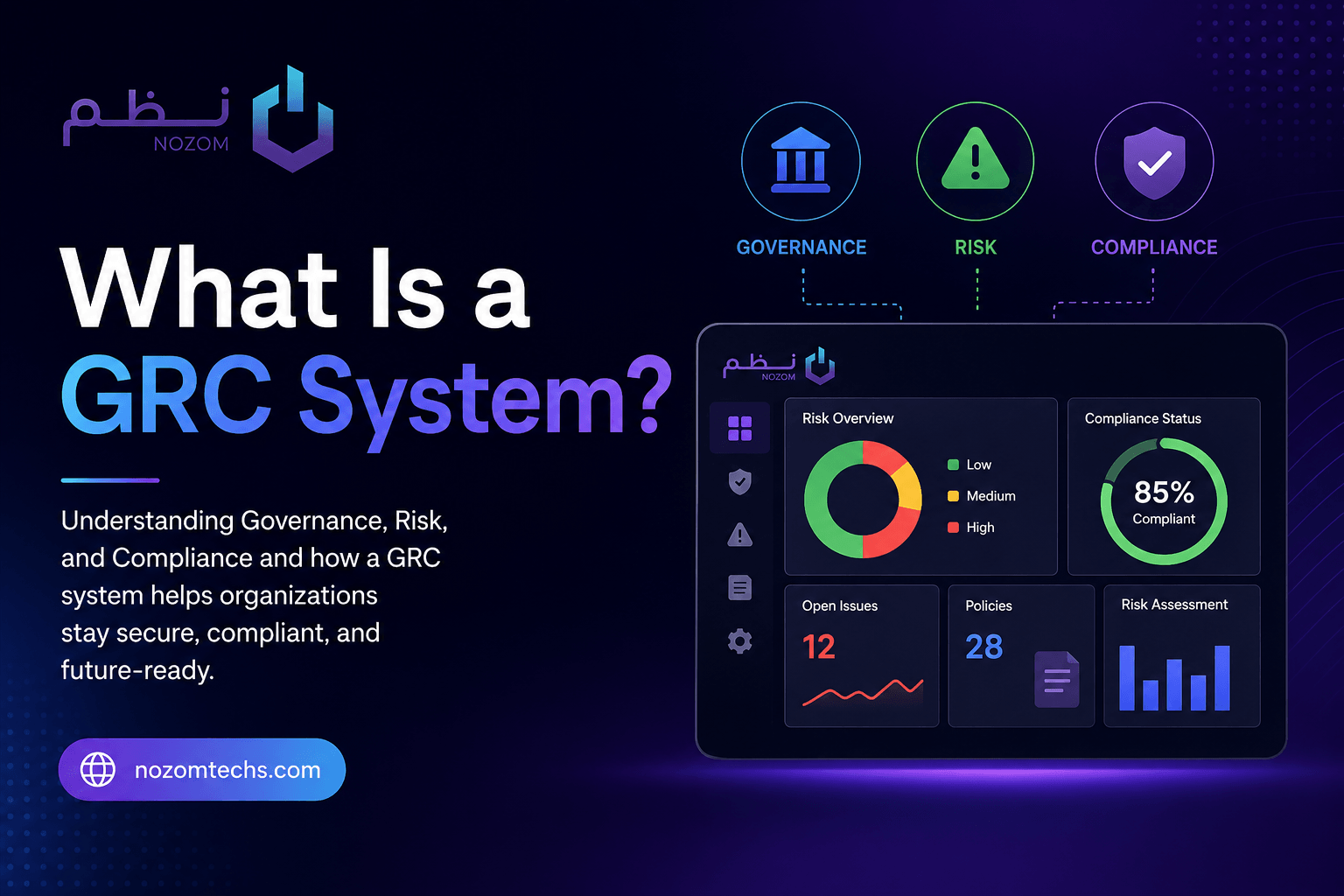
GRC stands for three concepts that break down when separated:
- G — Governance: The framework that defines how decisions are made, how responsibilities are distributed, and how an organization's strategic ambitions translate into its day-to-day actions.
- R — Risk Management: A structured methodology for identifying threats before they materialize, assessing their likelihood and impact, and taking proactive steps to address them.
- C — Compliance: The organization's adherence to laws, regulations, and standards — whether issued by external regulators or defined internally.
The fundamental insight is that these three elements are inherently interconnected. A compliance team that never communicates with the risk team, or a board that lacks a clear view of operational threats — these are exactly the kinds of gaps that quietly become crises.
What Does GRC Really Mean?
The Open Compliance and Ethics Group (OCEG) — the leading authority in this field — defines GRC as "an integrated collection of capabilities that enable an organization to reliably achieve objectives, address uncertainty, and act with integrity."
That definition runs deeper than it first appears. "Reliably achieving objectives" does not mean avoiding risk altogether. It means that risk becomes deliberate and data-driven — a calculated step forward, not a leap into the unknown.
Read also: Cybersecurity GRC
The Three Core Components of GRC
1. Governance
Governance is the structural foundation of any organization. In practice, however, many companies conflate having an organizational chart with having actual governance — and these are two very different things.
True governance means every decision has a clear owner, and policies are not documents filed away in a drawer. It operates across three practical dimensions:
- Authority and accountability structures: In governance-mature organizations, every employee knows who holds authority over what — and which decisions require escalation. This sounds obvious, yet it is notably absent in many regional firms that operate under an implicit "everything goes up to management" culture.
- Aligning strategy with operations: An ambitious annual plan is not governance. Effective governance ensures that strategic objectives are translated into measurable initiatives in daily operations — not just polished presentations.
- Meeting rising regulatory expectations: In the context of Vision 2030 and the Gulf's digital transformation agenda, governance requirements have grown significantly more complex. Organizations seeking government partnerships or entry into regulated sectors face levels of governance scrutiny that simply did not exist a few years ago.
2. Risk Management
In practice, risk management within a GRC framework differs fundamentally from the quarterly risk report that a department head assembles and distributes to the board. Mature GRC systems provide near-real-time visibility into risk and operate continuously — not as a periodic event.
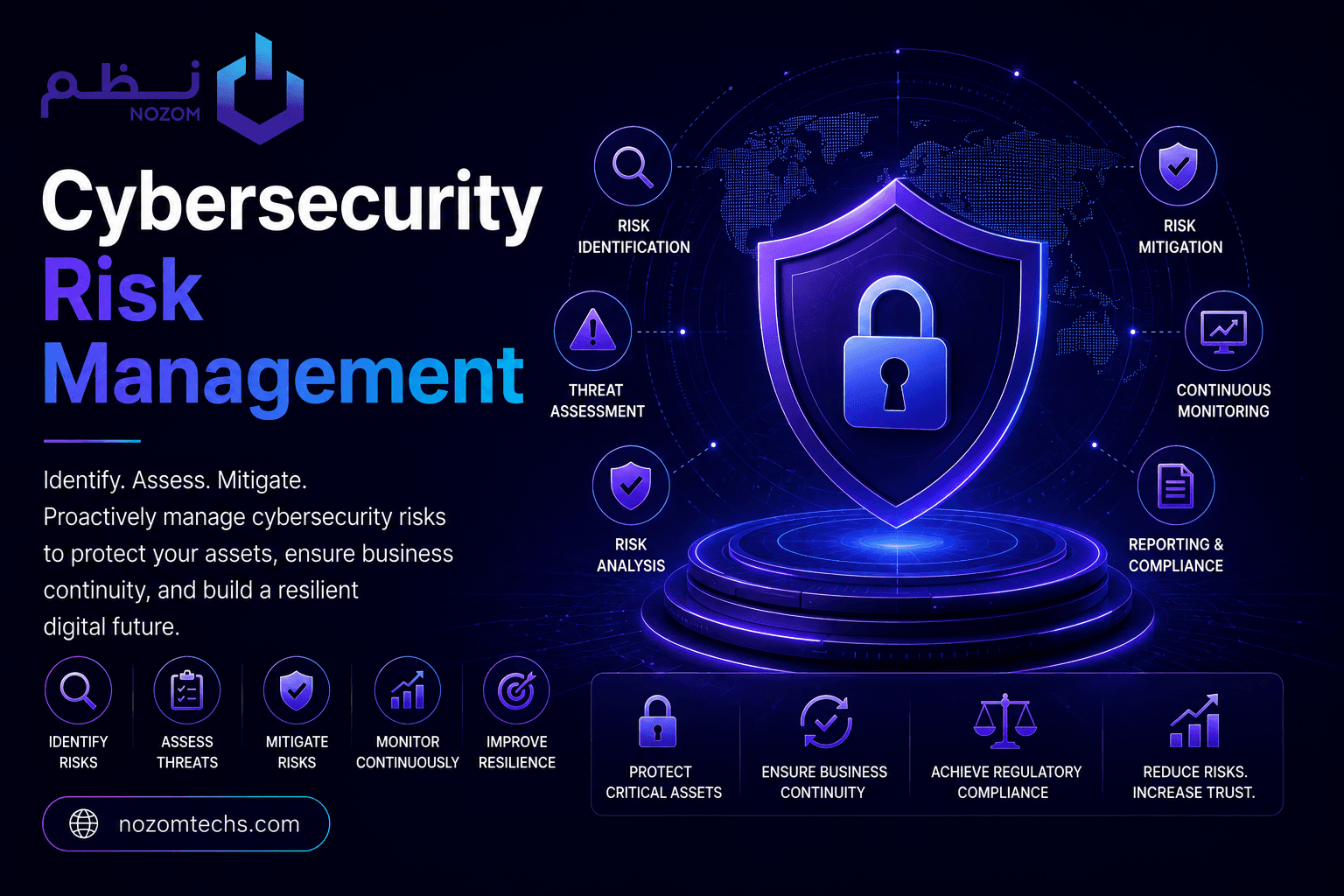
The risk management cycle runs through four recurring phases:
-
Identification — Scanning for potential threats at every level: strategic, operational, financial, technical, and regulatory.
-
Assessment and prioritization — Evaluating likelihood and impact to determine where to direct effort and resources.
-
Response — Making a deliberate choice: avoid the risk, mitigate it, transfer it (through insurance, for example), or consciously accept it.
-
Continuous monitoring — Because the business environment never stops changing.
A Gulf-based energy company might simultaneously face geopolitical risks, oil price volatility, cyberattacks on critical infrastructure, and evolving environmental regulations. A mature GRC system is what makes that level of complexity manageable.
Read also: Cybersecurity GRC & Compliance in Saudi Arabia
3. Compliance
Compliance is the most visible element of GRC, largely because it is tied to specific legal requirements with defined penalties. But reducing compliance to "don't break the law" is a dangerously narrow framing.
In the Gulf business environment, compliance operates across multiple layers:
- Regulatory: Requirements from the Communications, Space & Technology Commission (CST), the Capital Market Authority (CMA), the National Cybersecurity Authority (NCA), and NESA in the UAE.
- Sector-specific: PCI-DSS for payments, HIPAA for healthcare, SWIFT for financial services.
- International: ISO 27001, SOC 2, and GDPR for companies handling data belonging to European citizens.
- Internal: Policies and standards the organization has defined for itself.
Organizations that treat compliance as a checklist to fill out before each audit are the same ones that later find themselves facing fines and regulatory scrutiny. Real compliance is a culture, not a template.
Why Gulf Organizations Need GRC
A common question from executives encountering GRC for the first time: "Don't our existing compliance and internal audit teams already cover this?"
The short answer is no. And the reason has nothing to do with the competence of those teams — it is that the surrounding complexity has outgrown what siloed functions can manage on their own.
A Regulatory Environment in Acceleration
The past five years have brought an unprecedented wave of regulation across the region. In Saudi Arabia alone, this includes the Essential Cybersecurity Controls from the National Cybersecurity Authority, the Personal Data Protection Law (PDPL) — now in full effect with stringent obligations — and a growing body of requirements around critical operations governance, cloud computing, and data sovereignty. Organizations without an integrated GRC system typically discover compliance gaps only after a penalty has been issued.
Digital Transformation Expands the Risk Surface
Every step in a digital transformation journey — migrating data to the cloud, onboarding third-party vendors, scaling digital platforms — creates new capabilities and new vulnerabilities simultaneously. A GRC framework that connects cybersecurity to the broader risk landscape gives the board genuine visibility, rather than technical reports that only specialists can decipher.
Vision 2030 and Elevating Governance Standards
Vision 2030 — both implicitly and explicitly — demands advanced governance maturity from organizations seeking government partnerships or access to transformation incentives. Major initiatives such as NEOM and Vision Realty now require governance standards that were not mandatory just a few years ago.
Read also: CMMI vs TMMI
Traditional vs. Digital GRC
Where the Traditional Model Falls Short
The traditional approach relies on manual processes, spreadsheets, and reports that are typically prepared after events have already occurred. The core problem is not the effort involved — it is the architecture.
Delayed data means that by the time a report reaches the board, the environment has already changed. Information silos mean each department hoards its own data, and no unified organizational picture ever forms. Redundancy means the compliance team is collecting data that internal audit already compiles — just in a different format. And when an audit or incident occurs, demonstrating the effectiveness of controls becomes a logistical nightmare.
Integrated Digital Platforms
Modern platforms — ServiceNow GRC, Archer, MetricStream, OneTrust — have fundamentally changed the equation. Instead of fragmented and outdated snapshots, they offer a unified, near-real-time dashboard. Repetitive tasks — evidence collection, reminder notifications, control status updates — are automated. Every action is documented in a way that satisfies audit requirements. And leadership receives the reporting it actually needs, rather than a single report format for every audience.
The other critical differentiator is integration — with ERP systems, HR platforms, cybersecurity tools, and ITSM — ensuring that relevant information flows to the right people without manual intervention.
Read also: Cybersecurity Strategy
Benefits of an Integrated GRC System
A Single Source of Truth Instead of Competing Narratives
One of the most immediate benefits is that senior leadership finally receives one consistent picture. The CEO, CFO, and board members see the same numbers and the same assessments — not different answers from different departments to the same question.
Measurable Reduction in Compliance Costs
Research consistently shows that integrated GRC implementation can reduce compliance costs by 25–40% over three years. The source of those savings is clear: eliminating duplication, automating manual tasks, and building controls that can be reused across multiple regulatory requirements.
Faster Response When Threats Are Detected
When the cybersecurity team identifies a vulnerability, an integrated GRC system enables them to immediately map that vulnerability to the affected business assets, the resulting risk exposure, and the relevant compliance obligations. What once took weeks now takes hours.
Building Trust with Stakeholders
Investors, partners, and regulators naturally gravitate toward organizations that can demonstrate disciplined risk management. A company that can produce a clear GRC report within hours of a request is perceived very differently from one that needs weeks to piece together an answer.
Better Decisions, Not Just Better Instincts
When the board understands the real risk profile of a strategic decision, approving or rejecting it becomes a data-driven choice rather than a judgment call based on intuition. Calculated risk-taking is not the enemy of growth — it is a precondition for it.
The Risks of Operating Without GRC
Regulatory Fines
In recent years, Gulf regulators have issued multi-million-dollar fines to financial and healthcare institutions for compliance failures that could have been prevented with relatively straightforward controls. And the damage does not stop at the fine itself — regulatory proceedings become a matter of public record.
Reputational Damage
In a Gulf business environment where relationships are built on personal and institutional trust, reputational harm is often more damaging than the financial penalty. A single large client withdrawing their confidence can ripple through an entire network of relationships.
Operational Disruption
Unmanaged cyber incidents and operational risks do not just create immediate losses — they open months of rebuilding, for infrastructure and trust in equal measure. A company facing a ransomware attack without a mature GRC system often discovers it does not even have a clear picture of what it is recovering from.
Lost Opportunities
Companies that can demonstrate governance maturity win government contracts and strategic partnerships faster. The absence of GRC is not just an existing risk — it is a door that quietly closes on opportunities that will not come around again.
How to Implement GRC in Your Organization
Phase 1: An Honest Assessment
Before anything else — before the platform, before the consultant, before the budget conversation — answer a set of direct questions with genuine candor: What is our actual maturity level across each GRC pillar? Where are the highest-risk gaps? What regulatory requirements are approaching on the horizon? What are our current technical and human capabilities?
A GRC maturity assessment grounded in reality — not aspiration — produces a roadmap that can actually be executed.
Phase 2: Building the Organizational Foundation
No technology system operates in a vacuum. Before selecting a platform, the organization needs a clear GRC owner — whether a CISO, CRO, or CCO — with genuine authority and direct access to senior leadership. It also needs a risk framework that defines the organization's risk appetite and tolerance thresholds with board approval, and a unified risk language so that all departments work from the same definitions and rating scales.
Phase 3: Platform Selection and Implementation
Selection criteria should include: integration depth with existing systems such as SAP, Oracle, and Microsoft; Arabic language support and regional compliance coverage; total cost of ownership and pricing model; executive reporting capabilities; and a documented track record with comparable organizations in the region.
Phase 4: Continuous Improvement
The most common implementation mistake is treating GRC as a project with a finish line. In reality, it is an ongoing program that requires continuous employee training, periodic reviews of frameworks and policies, updated risk assessments as the environment shifts, and regular board-level reporting.
Key Challenges and Common Mistakes
Delegating a Business Decision to IT
This is perhaps the most prevalent mistake in the region. When the IT team is tasked with "implementing a GRC system" without meaningful involvement from business leadership, the result is a system that works technically but does not reflect actual business risks and does not serve real decision-making.
Copying a Framework Without Adapting It
Reference models such as COSO and ISO 31000 are excellent starting points — but they require substantial customization for the Gulf context: local regulations, regional decision-making dynamics, and the specific characteristics of each industry sector.
Prioritizing Compliance While Neglecting Strategic Risk
Compliance is measurable and verifiable, which makes it a natural focus of attention. But strategic risks — market shifts, competitive disruption, misaligned investment decisions — are typically the ones with the greatest long-term impact on the organization's future.
Buying the Technology Before Building the Process
Technology does not fix broken processes — it makes them run faster. Organizations that purchase a GRC platform before clarifying their risk management processes typically end up with an expensive tool that digitizes the chaos rather than resolving it.
Best Practices for Gulf Business Environments
Tie GRC to strategic objectives: In every board meeting, GRC reporting should be presented in the context of its impact on strategic goals — not as a standalone compliance update.
Build a culture, not a bureaucracy: The employee who flags risks without fear of reprisal, and who understands why policies exist rather than just what they say — that is genuine governance maturity that no software platform can manufacture.
Leverage regulatory pressure as a catalyst: Requirements from the NCA, SAMA, or the UAE Central Bank are not obstacles — they are a legitimate justification for securing leadership buy-in and meaningful GRC program funding.
Measure maturity annually: An annual GRC maturity assessment provides an objective benchmark for progress and creates a substantive basis for board-level discussions about required investments.
Connect GRC to business continuity: A mature GRC system links organically to business continuity plans and disaster recovery frameworks. Organizations that separate these functions are consistently caught off guard when a crisis actually occurs.
Frequently Asked Questions
What is the difference between GRC and traditional risk management?
Traditional risk management focuses on identifying and assessing risks. GRC is broader: it connects risk management to the governance framework and compliance obligations within a single integrated system designed to support strategic decision-making.
How much does implementing a GRC system cost?
Costs vary considerably. Full enterprise implementations can range from SAR 500,000 to several million riyals, but the return on investment is measurable — through reduced regulatory fines, lower compliance costs, and fewer operational incidents.
Do small companies need GRC?
Yes — but at an appropriate scale. A mid-sized company in a regulated sector such as financial services, healthcare, or telecommunications needs a GRC framework even if it does not initially need a full software platform. The principles and processes matter most.
What are the leading GRC platforms for the Gulf market?
ServiceNow GRC, Archer, MetricStream, and OneTrust all have a regional presence with local implementation partners. The right choice depends on your existing infrastructure, budget, and specific operational requirements.
How do I build the business case for GRC with my board?
The most compelling argument is not technical — it is the cost of inaction. Recent regulatory penalties in your sector, partner due diligence requirements, and the escalating threat landscape together make a persuasive case. Pairing those with a direct cost comparison between the investment and the cost of a single major incident typically closes the argument.
Are GRC and information security the same thing?
No. Information security is one component within the risk management pillar of GRC, but they are not synonymous. GRC encompasses operational, financial, and strategic risks, as well as a much broader regulatory compliance mandate.
Conclusion
In today's Gulf business environment, GRC is no longer a luxury — it has become a competitive requirement. Growing regulatory complexity, accelerating digital transformation, and an expanding threat landscape have created a market dynamic that rewards governance-mature organizations and penalizes those that lag behind.
The distinction between two companies in the same sector is not academic. An organization that views GRC as an enabling framework — one that supports better decisions and disciplined growth — builds a system that works for it. An organization that views GRC as a box-ticking exercise finds itself managing crises that were entirely preventable.